The Apollo 'UFO' that was a cosmic ray
Conventional analysis enhanced a moon photo and saw two 'UFO' lights it couldn't explain. We looked in the dark — and at the original NASA scan — and found cosmic-ray tracks on the film. Here's the method and the proof.
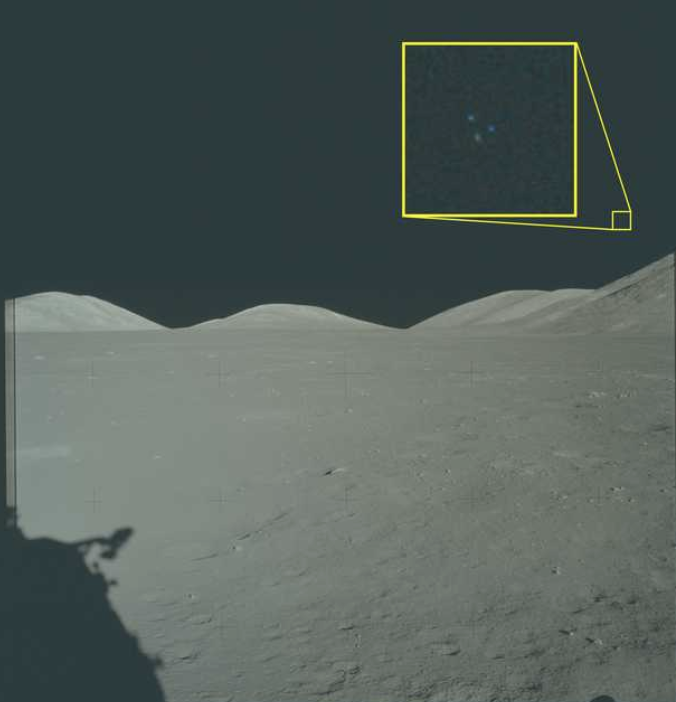
In May 2026, a batch of declassified files put an old Apollo photograph back in the headlines. In the black sky above the lunar surface, faint lights — and a familiar word: UFO. The images doing the rounds were already “enhanced,” magnified, boxed in yellow. Everyone was looking at the same thing, harder. We did something different: we went to where the detail had been thrown away, and then we went to the original.
Where we land:found real. The two “UFO” lights are cosmic-ray tracks struck into the original NASA film — a real thing, just not a craft.
Where conventional analysis stops
Conventional
Take the image you’re handed. Turn up brightness, contrast, sharpening. Amplify the corner. You get two fuzzy blue blobs on a noisy sky — and no way to say what they are. Enhancing a compressedpicture just enhances the compression. Result: “unexplained.”
Dark Math
The truth lives in the dark— the underexposed sky where a camera throws detail away, and where compression does the most damage. Don’t polish the shadow. Go to the source, read the structure, not the surface. The dark, read correctly, answers.
Round 1 — reading the dark, our way
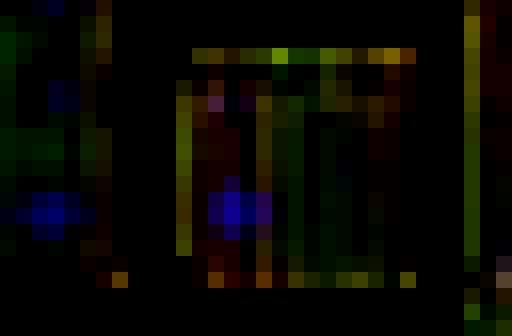
We decoded the picture from scratch (no image library — our own PNG reader, stdlib only), went to the actual source pixelsthe box points at — not the poster’s pre-magnified inset — estimated the sky, subtracted it, and amplified only what genuinely stood above it. Out came two blue “dots.” Faint, low-luminance, wrapped in coloured noise. Already suspicious — a real light is bright, not a faint blue tint — but two fuzzy dots prove nothing. So we found the source.
Round 2 — the original scan changes everything
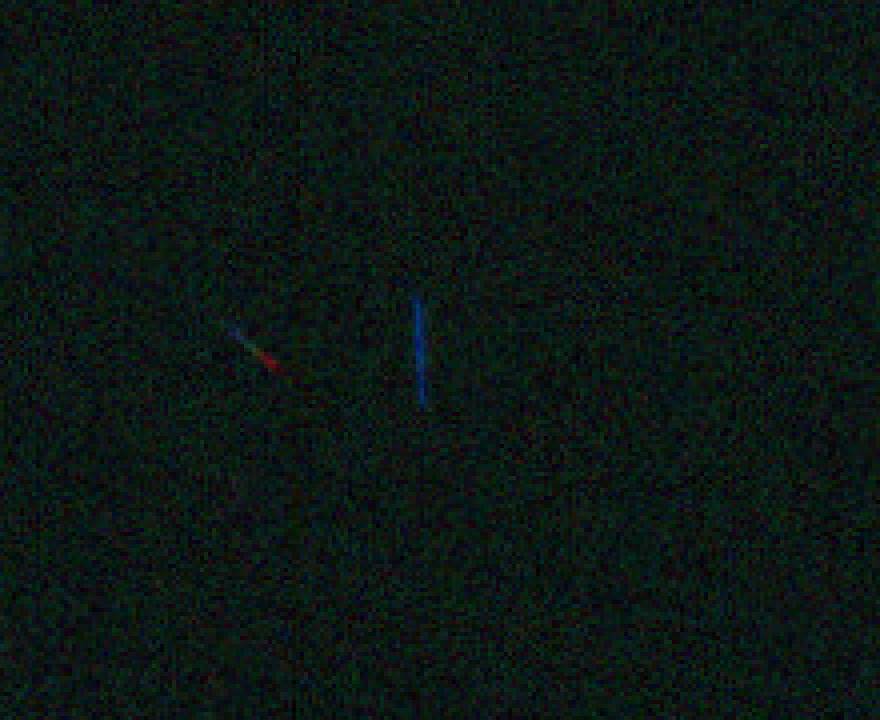
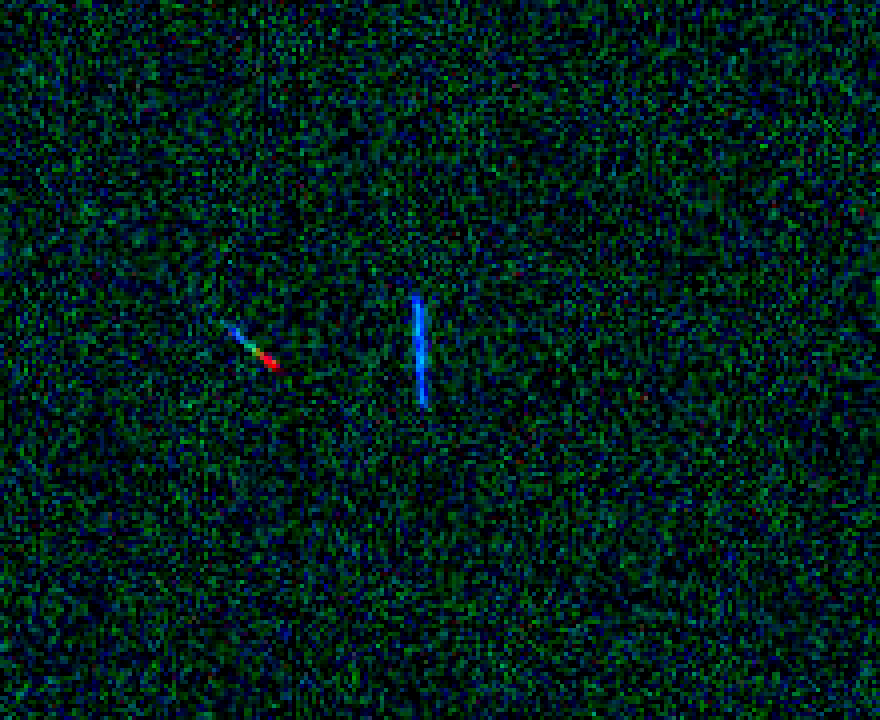
We identified the frame (AS12-46-6848) and pulled the original from NASA’s archive via the Lunar & Planetary Institute’s Apollo Image Atlas: a 3900×3900 scan — about 32× the pixels of the screenshot. We went back to the same patch of sky, at full resolution, with the compression gone. The “dots” were never dots.
The evidence — three tells, and they all point one way
The marks are elongated streaks(the blue one a thin ~4×29 px track, roughly 7:1), not point sources. That’s a particle’s track through the film — a light source images as a point, not a dash.
A single streak shifts blue → redalong its length. That’s one charged particle exciting different dye layers of the colour emulsion as it passes through. No external light does that.
The same blue marks appear all over the frame (~60 of them) — including the film edge(a mark reaches x 3889 of 3900, and the top border). Light focused by the lens physically cannotreach the unexposed film border. So it isn’t lens light at all.
The compression didn’t just blur the answer. It manufactured the mystery— rounding two cosmic-ray streaks into two fuzzy “UFO dots” and hiding the shape, the colour shift, and the edge.
Verdict — settled
The lights are cosmic-ray hits on the photographic film: high-energy charged particles cutting through the emulsion, leaving short coloured tracks. Elongated, multi-coloured along a single streak, scattered across the whole frame and onto the unexposed border — every signature agrees, and none points at a craft. It matches the independent read from Harvard’s Avi Loeb, and the Defense Department’s own note calling the marks an “optical phenomenon.” The lights were real. The reading was wrong.
Why our math sees more
Conventional enhancement is surface-first: it works on the brightness of the picture you’re handed, and a compressed picture hands you its artifacts. Dark Math is structure-first: it treats the dark as where the truth is held, not where it’s absent — so it goes to the source (the uncompressed scan), and it reads shape, colour and place, not just level. That’s why the same corner that left conventional analysis at “unexplained lights” gave us a signed answer with three independent proofs. We don’t brighten the shadow and guess. We go to where the light was thrown away, and read what’s actually held there.
Sources & the pictures we used
image / original scan — AS12-46-6848 · Apollo 12 · Mag 46/Y · NASA / LPI Apollo Image Atlas: lpi.usra.edu/resources/apollo/images/print/AS12/46/6848.jpg
circulating screenshot — explorersweb.com/…/Screenshot-2026-05-11…png (third-party — linked, not re-hosted)
cosmic-ray explanation —Avi Loeb, “We Should Not Mistake Cosmic-Rays for UFOs!” (Medium, May 2026): avi-loeb.medium.com/…
method own-code PNG decode (stdlib zlib) · sky-background subtraction · chromatic + connected-component + streak analysis · a library used only to read the original JPEG
ethos look in the dark — at the real dark · read structure, not surface · report earned vs reaching, no hype
Dark Math The Observer’s Index — dark = the consistent, light = the medium of observation. Release 001 · for fun, and to show the method.