The Face That Was a Hill
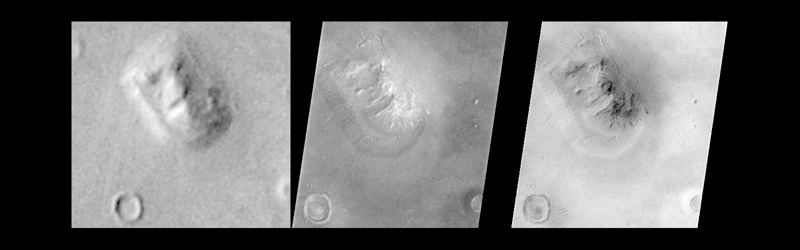
In 1976 a Viking orbiter caught a mile-wide Cydonia mesa, and the low sun drew a face on it. We didn't argue the pixels — we recovered the 3-D surface with own-code shape-from-shading. It's a shallow, eroded hill; re-lit from overhead, the face vanishes.
A face needs a certain shape: eye sockets that go in, a nose bridge that comes out, a mouth cut across. That’s 3-D relief— and relief is exactly what a single low-sun photograph hides and reveals at the same time. The brain, handed a fuzzy grey oval with two dark patches and a line, fills in a face for free. Our math doesn’t get that gift. It has to read the actual surface. So we made it.
Where we land: resolved. Own-code shape-from-shading rebuilds the terrain behind the light: a shallow, eroded hill. Re-lit from overhead, the face vanishes.
Where the argument usually stalls
Conventional
Look at the picture. “It looks like a face.” Sharpen it, argue about whether the eyes are symmetric, whether the nostril is real. You’re debating brightness — a 2-D shadow map painted by one sun angle at one moment. Pareidolia lives right there, and it never resolves.
Dark Math
Don’t argue the shadows — recover the shape that cast them. Shading encodes slope; slope integrates to height. Rebuild the 3-D relief and ask a question a shadow can’t fake: does this surface have the structure of a face, or of a hill?
We rebuilt the surface
From the high-resolution frame we ran shape-from-shading— own-code, the same structure-first math our 3-D engine is built on: estimate the sun direction from the image, read slope from brightness, and integrate slope back into a height field. Here’s the recovered relief, re-lit:
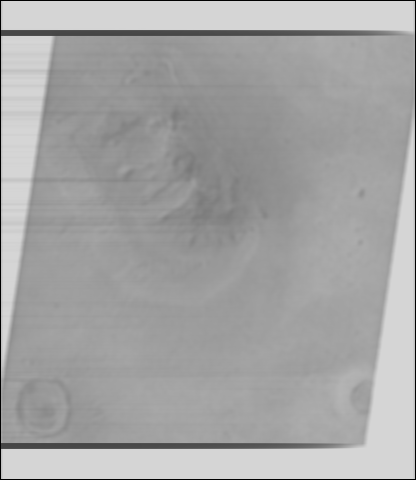
And that’s the whole answer. A carved face would have deeprelief — the “eyes” would be pits, the “nose” a ridge standing proud, the “mouth” a real trench. The recovered surface has none of that. It’s shallow: a gentle knoll with erosion texture. The “features” have no depth — because they were never shape. Light the same relief from overhead, and the face simply isn’t there:

A shadow can imitate a face. A surface can’t. The moment you read the structure instead of the brightness, the monument becomes a hill.
Verdict
The Face on Mars is an eroded mesa in Cydonia — a conclusion NASA reached with the high-resolution cameras of Mars Global Surveyor, Mars Express and MRO, and one our own structure-first math reproduces from a single frame: the relief is shallow terrain, not deep facial structure, and the “face” evaporates the instant you change the light. The pixels looked like a face. The structure never did.
Why our math sees more
Conventional image analysis is surface-first: it works on brightness, and brightness is a 2-D shadow map that pareidolia is built to exploit. Dark Math is structure-first: it recovers the thing that castthe shadows — the 3-D surface — and reads whether that surface holds the structure the eye claims. That’s why the same landform that kept conventional argument going for two decades gives structure recovery a one-line answer. We don’t debate the shadow. We rebuild what threw it.
Sources & the pictures we used
comparison image —NASA / JPL, “Mars Orbiter Camera Views the ‘Face on Mars’ — Comparison with Viking” (PIA01442): science.nasa.gov/…
Viking — frame 35A72 (P-17384), Viking 1 Orbiter, 25 Jul 1976 · MGS — MOC, 5 Apr 1998, 4.3 m/px (PIA01440–01442)
background — Cydonia (Mars) · NSSDC Cydonia
method own-code shape-from-shading (sun-azimuth estimate · slope-from-shading · plane-detrended integration · re-lighting) · a library used only to read the source JPEG
ethos recover the structure, don’t argue the surface · report earned vs reaching · single-image relief is approximate, and marked so
Dark Math The Observer’s Index — dark = the consistent, light = the medium of observation. Release 002 · for fun, and to show the method.