Five Pixels Can't Be a Cube
China's Yutu-2 rover photographed a “cube” on the lunar far side that was only a few pixels wide. At that size the image itself cannot decide the shape — the cube is an artifact of the pixel grid, not the object — though the rover later drove up and confirmed an ordinary rock.
In late 2021 China’s Yutu-2 rover, trundling across the far side of the Moon, photographed a cubeon the horizon. The internet named it the “mystery hut.” It was ~80 m away and a few pixels wide — and that last fact is the entire story. A shape needs pixels to exist. Below a handful, the camera makes cubes out of anything.
Where we land:resolved. At a few pixels wide the image can't decide the shape — the cube is an artifact of the pixel grid; the rover later drove up and found an ordinary rock.
Here is a lunar rock. Not a special one — a lumpy, ordinary boulder, drawn and lit by hand. Look at it at full resolution and it is unmistakably a rock: rounded lobes, a bright side, a shadowed side. Now do to it exactly what 80 m of distance and a rover camera did to the “mystery hut” — sample it down to a handful of pixels — and watch what you’re left with.
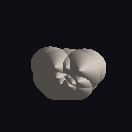


Same rock, every time. The “cube” isn’t a feature of the object — it’s a feature of the grid. Pixels are squares; when an object shrinks to a few of them, its edges snap to those squares and everything rounded becomes rectangular. That’s not evidence of a structure. It’s the camera’s ruler running out. You cannot recover a shape smaller than a pixel— and asking a 5-pixel blob whether it’s a rock or a building is asking a question the image physically cannot answer.
The “cube” was never in the rock. It was in the pixels. A shape you can only see because the resolution is too low to see it isn’t a shape — it’s a rounding error.
Verdict
The “mystery hut” is a rock— a conclusion Yutu-2 confirmed the honest way, by driving up to it over the following month (it turned out lumpy and rabbit-shaped, with a smaller “carrot” rock beside it). But the answer was decidable from the first frame without waiting: at a few pixels, cube and boulder are the same blob. Dark Math’s job here isn’t to solve the shape — it’s to say, out loud, that the shape is not solvable from that image, and to refuse the cube the eye wants to draw.
Why our math sees more
Surface-first vision fills in a hut, because that’s what brains do with a suggestive silhouette. Structure-first analysis asks first: is there enough information here to have a shape at all? When the object is a few pixels across, the honest answer is no — and knowing where the answer runs outis as much a result as any reconstruction. The cube didn’t need a rover to debunk. It needed someone to count the pixels.
Sources
event —Chang’e-4 / Yutu-2 far-side “mystery hut,” logged 3 Dec 2021; reached Jan 2022 → an irregular rock. Coverage: Space.com · EarthSky · Yutu-2 (Wikipedia)
the images above — a rock generated + degraded own-code to illustrate the resolution limit (the CNSA original is copyright — linked above, not re-hosted).
method own-code shape render · box down-sampling to a few pixels · the pixel-footprint limit on recoverable shape
ethos don’t read a shape out of noise · name where the information runs out · earned vs reaching
Dark Math The Observer’s Index — dark = the consistent, light = the medium of observation. Release 004 · for fun, and to show the method.