It Was Our Own Trash
A viral wad of 'string' on the floor of Jezero crater wasn't alien — it was Dacron netting shed from Perseverance's own landing hardware, blown across the crater and gone days later. Before you reach for the exotic, check what you brought.
In July 2022 the Perseverance rover looked down and found a tangled wad of stringlying on the floor of Jezero crater — a knot of pale filament that had no business being on an empty planet. Four days later the wind had carried it off. This one isn’t an illusion of shape or scale. It’s a question of bookkeeping: before you reach for the exotic, check what you brought.
Where we land:resolved. The viral “string” was Dacron netting shed from Perseverance’s own landing hardware. Check what you brought before reaching for the exotic.
Every spacecraft that lands on Mars arrives inside a storm of its own hardware. Perseverance came down under a supersonic parachute, dropped a heat shield, rode a rocket-powered sky crane, and cut the cables — scattering panels, foil and cord across kilometres of desert. Among that hardware: Dacron netting, the pale polyester mesh that reinforces thermal blankets. A knot of pale, stringy filament isn’t a mystery on that planet. It’s an item on the manifest.
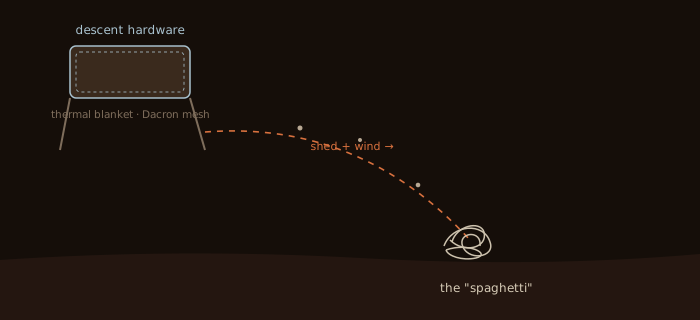
Known EDL debris on the Jezero floor
✓ Dacron netting — polyester mesh from thermal blankets · pale, stringy, tangles in wind
✓ Foil thermal blanket — a shiny scrap Perseverance had already found wedged in a rock weeks earlier
✓ Parachute + backshell — imaged from orbit, ~2 km away
✓ Sky-crane cabling — cut and flown clear at touchdown
The wad matched the first line on that list. It was light enough to blow away in four days — exactly what a scrap of polyester mesh does and exactly what a rock, a bone or a machine does not. Nothing about it needed a new category of explanation. It needed the packing list.
The strangest thing on an empty planet is usually the last thing that arrived. And on Mars, the last thing that arrived was us.
Verdict — resolved
Landing-hardware debris— most likely Dacron netting from a thermal blanket, shed during entry, descent and landing and blown across Jezero. Confirmed the honest way: it was gone with the wind within days, the signature of lightweight human litter, not a natural formation or an artefact. It’s our own trash — the first archaeology of Mars is going to be ours.
Why our math sees more
Surface-first vision sees “string where string shouldn’t be” and reaches for the exotic. Structure-first analysis runs the accounting first: what is knownto be here, and does the observation collapse onto a known item before we invent a new one? On Mars the known list starts with the hardware we flew. Most “impossible” objects are perfectly possible once you stop treating the scene as empty — and count what you yourself put there. Check the manifest before you cry alien.
Sources
event —Perseverance front Hazcam, Jezero crater, ~12 July 2022; gone by ~16 July. NASA/JPL-Caltech. Coverage & the Dacron-netting / EDL-debris identification: Space.com · NASA/JPL · Perseverance (Wikipedia)
the diagram above — a provenance illustration (own-code SVG); the NASA image is linked, not re-hosted.
method provenance accounting · the EDL debris manifest · the “empty scene” fallacy · lightweight-litter signature (blows away)
ethos count what you brought before inventing what you didn’t · the scene is never empty · report earned vs reaching
Dark Math The Observer’s Index — dark = the consistent, light = the medium of observation. Release 006 · for fun, and to show the method.