The Object That Won't Close
The first interstellar object was hyperbolic, wildly elongated, and it sped up leaving the Sun with no visible tail — and we reproduce all three facts in own-code. But the cause of that push stays genuinely degenerate: hyper-volatile outgassing (the leading natural explanation) and a radiation-pressure sail (the fringe alternative) fit the same tiny acceleration, and the astrometry cannot separate them. The mechanism is unresolved; the verdict is held open, on purpose.
On 19 October 2017 a telescope in Hawaii caught something falling through the solar system on a path that could only have come from another star. It was tumbling, wildly elongated, and as it left it sped up— pushed by a force that gravity alone can’t supply, while showing no comet’s tailto explain the push. Every other case in this series ended in a clean verdict. This one doesn’t — and that’s the point. The method’s hardest job isn’t dispelling a mystery. It’s holding one honestly.
Where we land:held open, on purpose. All three facts reproduced in own-code — but hyper-volatile outgassing and a radiation-pressure sail fit the same push, and the astrometry can't separate them.
Three things about ‘Oumuamua are measured facts, not interpretations. Its orbit was hyperbolic — it was never bound to the Sun. Its brightness swung by a huge factor as it tumbled, which only an extreme shape can do. And its outbound path bent away from the pure-gravity prediction, betraying a gentle extra push. We reproduce the orbit and shape from the numbers, and illustrate the push, in our own code. What we cannotdo — what nobody yet can — is say what the push was. Here’s the dark, drawn exactly as wide as it really is.
1 · The shape: a light curve that needs a splinter
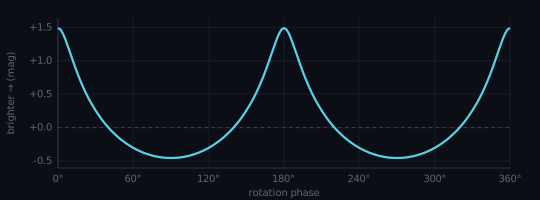
‘Oumuamua was a point of light — far too small to resolve. But a tumbling body betrays its shape by how its brightness rises and falls: a long object shows a big face, then an edge, then a big face again. Below is the light curve of a rotating 6:1:1 ellipsoid, computed own-code from its projected area. Two peaks per rotation, and an amplitude of 1.95 magnitudes.
2 · The push: a bend gravity can’t make
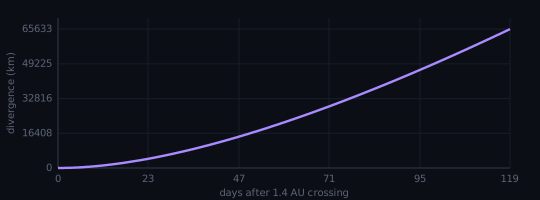
From the point on the outbound arc where the object sat at 1.4 AU — the geometry Micheli and colleagues actually tracked — run the path twice from the samestate: once under the Sun’s gravity alone, once with the measured non-gravitational push — 5×10⁻⁶ m/s² at 1 AU, falling off as 1/r² (so about 2.6×10⁻⁶ m/s² out at the 1.4 AU tracking point). Integrated own-code with RK4, the two paths peel apart to a 65,633 km gap in 120 days — the same order as the real reported deviation, a 30-sigma detection against the telescope’s error bars. The push is real, and it follows a comet’s 1/r² law.
3 · The knot: two answers, one number
So something pushed it. A comet outgasses and the escaping vapour shoves it — but outgassing carries dust, and dust makes a tail, and ‘Oumuamua had none anyone could see. Take away outgassing and the next candidate is sunlight itselfpushing on a big, light sail of an object. Both explain the exact same 5×10⁻⁶ m/s². Neither can be ruled out by the trajectory, because they leave the same1/r² fingerprint. That is the knot — and here is why the number alone can’t cut it:
Radiation pressure
Sunlight pushes on area. To get 5×10⁻⁶ m/s² it needs an area-to-mass of
A/m ≈ 1 m²/kg
A rock’s is ~0.0001 — ten thousand times less. A splinter of solid rock can’t be that light. You need something gossamer: a fluffy fractal aggregate… or, as one camp argued, something made. That is the fringe reading.
Cometary outgassing
Escaping ice supplies the thrust at normal density — no exotic thinness required. This is the leading natural explanation. But comets that outgas this hard show a bright dust coma.
observed tail: none
Rescue it with an invisiblepropellant — pure H₂ or N₂ ice that sublimes without dust. Plausible, but never seen before, and its own kind of exotic.
Both doors fit the key. The astrometry that proves the push exists is the very thing that can’t tell you which door it came through. The honest result isn’t an answer — it’s the exact shape of what we don’t know.
Verdict — held open
‘Oumuamua is almost certainly a natural object— but a genuinely strange one, and the mechanism of its acceleration is still unresolvedin the literature (hyper-volatile outgassing is the leading natural explanation; a radiation-pressure sail remains the fringe alternative). Dark Math does not collapse this to a tidy verdict, because the data doesn’t. What it does is draw the uncertainty at its true width: the shape is extreme (measured), the push is real (measured), and the cause is degenerate (two models, one number). Naming exactly where the light runs out is the finding.
Why our math sees more
Surface-first thinking wants a headline — “comet” or “aliens,” pick one. Structure-first analysis separates the invariant(orbit, elongation, acceleration — the dark that every observer agrees on) from the interpretation(the mechanism — the light that the data underdetermines) and refuses to spend certainty it hasn’t earned. The discipline that debunked five mysteries in a row is the same discipline that, here, says not yet.Holding a doubt at its real size is not failure to answer. It’s the answer.
Sources & method
object —1I/2017 U1 (‘Oumuamua). Discovered Pan-STARRS 1, 19 Oct 2017. Non-gravitational acceleration: Micheli et al., Nature 559 (2018): nature.com/articles/s41586-018-0254-4
natural-mechanism reviews —‘Oumuamua ISSI Team, Nature Astronomy(2019) · Seligman & Laughlin (2020, N₂ ice) · Bergner & Seligman (2023, H₂). Overview: ‘Oumuamua (Wikipedia)
computed here —light curve = projected area of a rotating triaxial ellipsoid; trajectory = RK4 integration of the outbound hyperbolic leg (q=0.255 AU, e=1.20) with vs without a 1/r² radial term calibrated to 5×10⁻⁶ m/s² at 1 AU; degeneracy = radiation-pressure A/m vs outgassing. Own-code, stdlib math only. Every curve above is those arrays.
method own-code light-curve · own-code orbit integration · the measured-vs-interpreted split · model degeneracy as a first-class result
ethos hold the doubt, don’t collapse it · name where the light runs out · separate the invariant from the interpretation · earned vs reaching
Dark Math The Observer’s Index — dark = the consistent, light = the medium of observation. Release 007 · the one we didn’t close, on purpose.