The Star That Plunges
A star that dips in jagged drops with no rhythm and no repeat — briefly the best SETI megastructure candidate in the sky. The colour of its dimming rules a solid structure out, but what wraps a mature star in ragged, fading clouds of dust — the aperiodicity and the century-long fade — stays unexplained. Held open.
A star that dips by up to 22%, in jagged drops with no rhythm and no repeat. For a moment it was the best SETI candidate in the sky. The colour of its dimming quietly ruled out a megastructure — but what wraps a grown star in ragged, fading clouds of dust is still not settled.
Where we land: held open. The colour of the dimming rules out a solid megastructure and points to dust; the aperiodicity and a century-long fade stay unexplained.
In 2015 a star 1,470 light-years away in Cygnus did something no star is supposed to do. Its light didn’t wink the way a planet makes it wink — a shallow, clockwork 1% dip. It plunged, by as much as 22%, in jagged drops with no period and no repeat. KIC 8462852 — “Tabby’s Star” — became the most famous stellar mystery of the decade, and for a while the most exciting three letters in astronomy were attached to it: SETI. Structure-first analysis can’t tell you what dimmed it. It can tell you, exactly, how strange the dimming is — and why one clean answer still doesn’t fit.
1 · A canyon where a planet makes a scratch
A transiting planet blocks a fixed sliver of its star, on a fixed clock. Below, that’s the thin cyan line: a 1% dip, identical every orbit. The gold line is a Tabby-like light curve, computed own-codefrom a sum of irregular dips plus a slow secular fade. Same axes. The planet is a scratch; Tabby is a canyon — and an arrhythmic one.
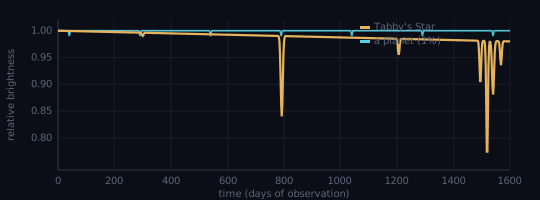
How big must the thing be? A dip of 22% means something covered 22% of the star’s disc. As a single sphere that’s a radius of 0.47× the star— about 0.7 times the width of our Sun. A Jupiter-sized planet, by contrast, would block just 0.40%. Nothing that orbits as a solid ball does this. Whatever passed was vast, ragged, and probably a swarm — which is exactly why, for a heady moment, people said the word “megastructure.”
2 · The colour of the answer
Here’s the test that quietly deflated the aliens. A solid object — a panel, a shell, a Dyson swarm — is opaque: it blocks blue light and red light equally. It dims you grey. Fine dust doesn’t: small grains scatter blue more than red, so a dust cloud dims you bluer. When the star dipped again in 2017 and was caught in multiple colours, the dips were deeper in blue. That’s dust’s fingerprint, not a solid structure’s.
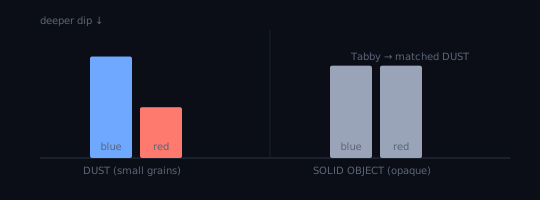
Dust is the best answer we have. But “dust” is a description of the material, not of why a mature F-type star is wrapped in ragged, uneven clouds that also seem to have faded it for a century.
3 · What dust doesn’t finish
The colour test rules a solid megastructure out, and that’s real progress. It does not close the case, and the honest reason is that “circumstellar dust” raises its own questions the data hasn’t answered: why so much, why so uneven, why now, and what about the slow century-scale fadingreported in old photographic plates (itself disputed — some read it as a plate-calibration artifact), which a transient dust cloud doesn’t naturally explain? Exocomet swarms, a shattered planetesimal, an accretion episode, even intervening interstellar material have all been floated. None yet accounts for allof it at once. The mystery shrank; it didn’t vanish.
Verdict
Almost certainly natural, and almost certainly dust — the colour-dependence killed the megastructure. But the source and structure of that dust, the aperiodicity, and the long secular fade are not settled. Dark Math’s read: the alien answer is out, the dust answer is leading but incomplete, and pretending otherwise would spend certainty the light curve hasn’t earned. Held open — with the doubt now much smaller, and much better-shaped, than in 2015.
Why our math sees more
The headline swung between “aliens” and “case closed,” and both overshot. Structure-first analysis holds the measured facts — depth, aperiodicity, colour-dependence, secular fade — as the invariant, and treats every mechanism as a claim that must fit allof them. A solid megastructure fails the colour test and is out. Dust passes the colour test but hasn’t yet passed the others. Naming that gap precisely is the finding.
Sources & method
object —KIC 8462852 (Boyajian’s / Tabby’s Star). Discovery: Boyajian et al., MNRAS457 (2016, Planet Hunters). Colour-dependent 2017 dips → dust: Boyajian et al., ApJL853 (2018). Secular dimming: Schaefer (2016); Montet & Simon (2016). Overview: Tabby’s Star (Wikipedia)
computed here — light curve = baseline minus a sum of Gaussian dips (irregular, aperiodic) plus a linear secular fade, vs a periodic planet dip; occulter size from the 22% area block; colour test = illustrative blue/red dip depths for dust vs a grey opaque body. Own-code, stdlib math only.
method own-code light curve · occulter-size from transit depth · the blue-vs-red colour discriminator · fit-all-the-facts test
ethos rule out what fails · don’t crown what merely leads · name the gap precisely · earned vs reaching
Dark Math The Observer’s Index — dark = the consistent, light = the medium of observation. Release 008 · held open (2 of 6).