The Signal That Never Came Back
For 72 seconds in 1977 the Big Ear telescope heard a narrowband burst far louder than the sky, at the one frequency physics would pick to say hello, and it rose and set exactly as a real celestial source would. It never repeated. Held open, and possibly unfalsifiable: a one-off signal can be neither confirmed as a message nor dismissed as mundane.
On 15 August 1977 the Big Ear radio telescope in Ohio was listening to the sky one strip at a time, letting the Earth’s rotation sweep the heavens past a fixed beam. A computer printed the strength of each channel as a single character — a digit, or a letter for anything strong. Days later the astronomer Jerry Ehman ran his eye down the fanfold paper, saw six characters that didn’t belong, circled them in red, and wrote one word in the margin: Wow! The code was 6EQUJ5. Nearly half a century later it has never come back, and no one has explained it. This is the rare case where the honest verdict may be permanentlyopen — and the maths shows you why.
Where we land:held open, and possibly unfalsifiable. A 72-second 1977 burst that never repeated — neither confirmable as a message nor dismissable as mundane.
1 · What 6EQUJ5 actually says
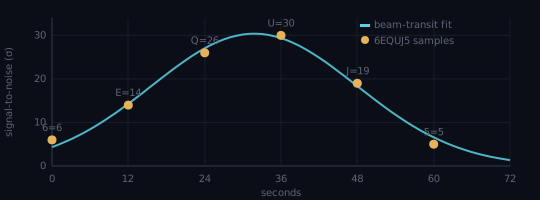
The characters aren’t a message — they’re a graph. Big Ear ranked each 12-second sample by how far it stood above the background noise: 1–9, then A–Z for 10–35. Decoded, 6EQUJ5 is the signal-to-noise sequence 6, 14, 26, 30, 19, 5 σ. It rose, spiked to 30σ— thirty times the noise, unheard-of — and fell, all in 72 seconds.
2 · The tell: it moved like the sky
Here’s the part that rules out a broken radio on Earth. Big Ear’s beam was fixed; the sky drifted through it as the planet turned. Any real celestial point source must therefore rise and fall in a specific shape— the Gaussian profile of the beam — over exactly the time it takes to cross. Fit that beam-transit Gaussian to the six numbers (grid-search, own-code) and they fall on it almost perfectly:
It was also narrowband— squeezed into less than 10 kHz, right at the 1420 MHz hydrogen line, the most natural “hailing frequency” in physics and a band kept legally quiet on Earth. Terrestrial interference is broadband and doesn’t obey the sky’s clock. This did both.
3 · The trap: a one-off can’t be settled
So why isn’t this a discovery? Because it happened once.Big Ear had two feed horns; the signal showed in one, leaving two possible positions and no way to choose. Every follow-up — Big Ear itself, the VLA, META, Arecibo, hundreds of hours — found nothing. And a single, non-repeating event is caught in a vice:
To confirm it
you need it to repeat, so you can localise it, track it, take its spectrum. It has stayed silent for nearly half a century.
repeats: 0
To dismiss it
you need a mundane source that reproduces allof it — the beam-transit shape, the narrow band, the 30σ. The 2017 comet idea was tried and failed(comets don’t radiate like that, and weren’t there); RFI doesn’t drift with the sky.
explanations that fit: 0
A signal that never repeats can be neither confirmed nor refuted. The Wow! isn’t unexplained because we haven’t looked — it’s unexplained because the one thing that could settle it, a second look at the same signal, is the one thing it never gave us.
Verdict
The Wow! Signal is real data that behaved exactly like a genuine celestial source— the beam-transit fit is clean, the band is natural-yet-artificial-friendly, the strength is extraordinary. It is not demonstrably a message, and not demonstrably mundane. Because it never repeated, it may be the purest example in this series of a doubt that cannot be closed— not for lack of effort, but by its own structure. Dark Math records it for what it is: a 30σ question mark that the universe asked once and never again.
Why our math sees more
The surface reading is a coin-flip: “aliens” or “nothing to see.” Structure-first analysis separates the invariant(the decoded S/N, the beam-transit shape, the narrow band — all measured, all reproducible from the printout) from the unanswerable(the source, foreclosed by non-repetition). It refuses the coin-flip and instead states precisely what is known, what isn’t, and why the unknown part is structurally out of reach. Naming an unfalsifiable doubt as unfalsifiable is itself the honest result.
Sources & method
event —Big Ear (Ohio State SETI), 15 Aug 1977; discovered by Jerry Ehman. Code 6EQUJ5, ~1420 MHz, <10 kHz, ~72 s. Comet hypothesis: Paris & Davies (2017) — widely rejected (follow-ups found no narrowband 1420 emission). Overview: Wow! signal (Wikipedia) · Ehman’s retrospective (NAAPO).
computed here —decode 6EQUJ5 via Big Ear’s 1–9 / A–Z S/N scale; least-squares grid-fit of a beam-transit Gaussian A·exp(−((t−t0)/w)²) to the six samples (best: A=30.4σ, FWHM=38 s, RMSE=1.1σ). Own-code, stdlib math only.
method own-code intensity decode · least-squares beam-transit fit · the confirm/refute vice of a non-repeating event
ethos state what’s known and what’s structurally unknowable · refuse the coin-flip · earned vs reaching
Dark Math The Observer’s Index — dark = the consistent, light = the medium of observation. Release 009 · held open (3 of 6).