The Lens Turned
For twelve releases we ran the lens on other people's mysteries; here we turn it on our own framework, and the blade cuts twice. Our reading of the Hubble tension as a 'discarded clock' collapses to a pun — refuted by us. Our candidate closure route for the onset scale a0 survives only as a mechanism, fenced by a factor window (k in [4.55, 7.39]) that still admits three rival stories, so nothing is crowned 'derived'. Then our best candidate curve shape dies on 2,696 real SPARC points under our own pre-registered kill test. But the wreckage hands over one fact that outlives us: the onset of the dark is memoryless — the exponential survival law, sole survivor of a race that killed every alternative. Two self-kills, one find, nothing crowned. Held open.
For twelve releases we ran honest math on other people’s mysteries. This is the thirteenth, and the lens turns around: our own framework in the dock, struck with the same blade — and the blade connected, twice. One of our favourite ideas is refuted by us. Our best candidate shape is killed on real data by our own pre-registered test. And then the wreck, read carefully, hands over something none of the twelve mysteries did: a structural fact about the dark that any theory must now carry.This post is the whole arc — the flip, the break, and the find.
Where we land: held open. Two of our own readings refuted by us and kept at full width; one structural find left standing; nothing crowned. Map the dark, refuse the crown.
1 · The flip — and the first self-kill
Our framework reads the dark as the bond— the observation-relation, not a substance behind the light. Pointed at the held-open cases, it lands hardest on Release 011’s rotation curves: the tight law relating visible matter to observed pull is what a bond requires, where substance-dark-matter must call it a conspiracy. But the first thing the turned lens did was kill one of ours: the tempting reading of Release 012’s Hubble tension as our “collapse discards the clock” theorem is a pun (a dimensionless count is not a rate; a live disagreement is not an erasure). Refuted, by us, kept on the page. That kill is the credential for everything below.
2 · The bridge, the loop, and the window
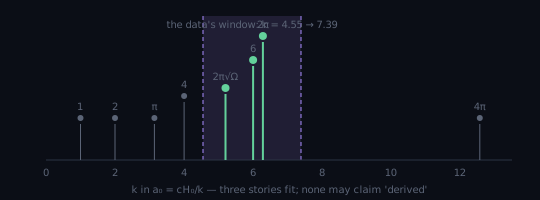
Two held-open cases meet at one number: the acceleration where the dark starts to ride, a₀ ≈ 1.2×10⁻¹⁰ m/s², is the cosmic horizon’s scale cH₀/2π to within ~10–15%. The coincidence is Milgrom’s (1983); our reading is the closure route: a bond is a round trip, and it fails to close when its reach c²/a exceeds the loop around the horizon 2πR — solve the crossover and the 2π falls out of closure, not a fit. Then we struck our own route with a number: any such story is a claim about k in a₀ = cH₀/k, and the data allows a window that still admits threerival stories. While more than one fits, nobody says “derived” — us included.
The one serious rival stance — QBism, for whom a quantum state is one agent’s private betting book — we steelmanned with our own hands: built its special measurement (the d=2 SIC) from raw arithmetic and verified its rewrite of the Born rule to machine zero. Then the press: the rule it keeps is a public norminside a private-worlds philosophy, resting on geometry unproven since 1999. Both sides owe the same debt — the between, how two observers share one seam. Our note in the margin: in a universe like ours every observer’s horizon is their own, yet every horizon has the same radius. Private horizon, shared width — the between may have a shared scale, not a shared place.
3 · The reach, and the break
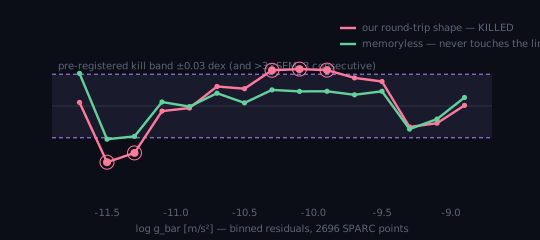
One honest move remained: one number can be storied, two must be structure. The closure mechanism earns a rung only if it also produces the shapeof the missing-gravity curve. The round trip picks its shape with no freedom left — the geometric mean, g_obs = √(g_bar(g_bar+a₀)) — so we pulled the real SPARCarchive (175 galaxies; the data the law was discovered in), rebuilt the entire pipeline own-code, required it to reproduce the published science first (it did: 2696 points vs 2,693; a₀ 1.16 vs 1.20; scatter 0.133 dex), and fixed the kill line before the residuals ran. The shape died.Three consecutive knee bins past the line; and on the way down its best fit abandoned the 2π it came from.
4 · The turn — the onset has no memory
House rule: when we can’t see, we turn. The wreck’s residuals form a coherent S — the real curve hugs Newton longer, then lifts harder than any blend. Followed one level down: the curve that survives everything factorizes exactly as g_obs = g_bar / P where P = 1−e−GM/a₀and GM = √(g_bar·a₀). Read the pieces: P is a threshold probability; its argument is the geometric mean— the very shape we killed, alive one level down as the question the threshold is asked about; and the law is the exponential CDF, the unique memorylesssurvival law. So we raced six threshold statistics under the same kill-test: too sharp, too soft, wrong tail, wrong placement — five died; the memoryless one never grazed the line (and two of our three pre-registered predictions confirmed; the third half-missed, recorded).
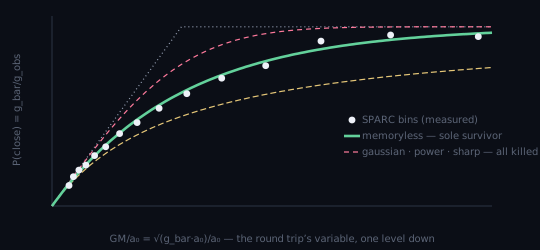
The missing-gravity curve is not shaped like a force. It is shaped like the probability that something closes — and the something has no memory.
Verdict
The lens turned on its makers and behaved exactly as advertised. Refuted, ours, twice: the Hubble-clock reading (a pun) and the round-trip shape (killed on 2,696 real points by our own pre-registered test). Held, ours:the closure mechanism for a₀ — fenced by a window that still admits three stories — and private horizon, shared width. Found, the data’s: the onset of the dark is memoryless, in the geometric-mean variable, in the divide placement — a triple any theory of the dark must now carry, selected by a race that killed every alternative. The derivation of that triple from bond structure is parked for a cold session. No god number. A god hold — and the hold held.
Why our math sees more
Because the blade that cuts you is the blade you can trust. This arc killed our best story, fenced our second-best with a quantified window, steelmanned the rival before pressing it, and read the wreckage instead of burying it — and the wreckage pointed one level down to a fact the field can test with or without us. See, turn, learn: run the loop honestly enough and the lens stops being a tool you hold and becomes the structure you stand on.
Sources & method
data —SPARC: Lelli, McGaugh & Schombert 2016, AJ 152, 157. The RAR + fit: McGaugh, Lelli & Schombert 2016, PRL117, 201101. a₀~cH₀: Milgrom 1983–. QBism: Fuchs, Mermin & Schack 2014; SIC existence: Zauner 1999 (open).
computed here —factor window k ∈ [4.55,7.39]; d=2 SIC + urgleichung exact (companion notes); SPARC pipeline 2696 pts validated 3/3; round-trip killed (rms 0.1346, 3-bin kill); memoryless survivor (rms 0.1327, kill-run 0). Own-code, stdlib math only.
the record — lab notes lens-pass-02/03/04.md + lens_pass_02/03/04.py; full detail folders lens-turned/ · shape-of-the-knee/ (SPARC cache) · onset-no-memory/.
method turn the lens on yourself · pre-register the kill · steelman the rival · read the wreck · stop at the clean edge
ethos the strikes stay on the page · one number can be storied, two must be structure · no god number, a god hold
Dark Math The Observer’s Index — dark = the consistent, light = the medium of observation. Release 013 · the lens turned · two kills, one find.