The Voynich, Held
We ran the Voynich manuscript's raw transliteration through our own-code structural pipeline: its letter order is more rigid than real language, its words are stamped to a five-glyph template with a positional grammar, and it splits into two Zipfian dialects. That structure is real — and it is equally explained by a real language, a cipher, or a generation procedure. We refuse to pick one. Held open.
For six hundred years the Voynich manuscript has done one thing to everyone who opens it: it invites a collapse. Look at the looping script, the impossible plants, the bathing women, and the mind reaches for an answer— a language, a cipher, a solution. The graveyard of “I cracked the Voynich” is the largest in the humanities. So we did the opposite of cracking it. Our whole discipline is one rule — grade the held structure, not the collapsed answer— and here it means: don’t reach for the meaning. Measure the dark. Characterise the order that is provably there, name the exact seam we cannot cross, and refuse the crown. Everything below is own-code from the raw transliteration; the one thing we will not do is tell you what it says.
Where we land:held open. The structure is real — and equally explained by a real language, a cipher, or a generation procedure. We refuse to pick one.
1 · The book, counted
We took the ZL transliteration(Zandbergen–Landini, the modern standard, every glyph in the EVA alphabet) and parsed it ourselves: 37,726 word-tokens, 8,236 distinct word-types, 71%of those types occurring exactly once. The single most common “word” is daiin, 794 times; then ol, chedy, aiin, shedy. Nothing here is transcribed by hand into our numbers — the file is parsed, cleaned (ambiguous glyphs resolved to their first reading, 399 unreadable tokens dropped and counted, never faked), and every figure is drawn from the arrays that fall out.
2 · The dark is rigid — it is more ordered than a language
The first measurement is the one that has haunted the manuscript for decades, and it survives our own-code hands. Take the stream of glyphs and ask: how much does one letter tell you about the next?That is conditional entropy, h₂ — low means rigid, predictable, templated; high means free. We computed it for the Voynich and, on the identical pipeline, for a full English novel and four books of Caesar’s Latin:
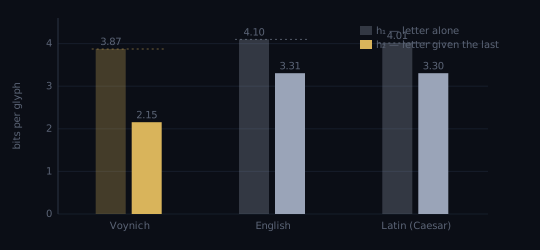
This is the crux, in our framework’s own words: the Voynich carries an enormous dark— a structure tighter than any natural language we measured. Whatever produced it was following rules far more binding than grammar. That is not a hunch; it is 1.15 bitsof measured order, per letter, beyond English — its conditional entropy h₂ sits 1.15 bits below English’s.
3 · The words are stamped from a mould
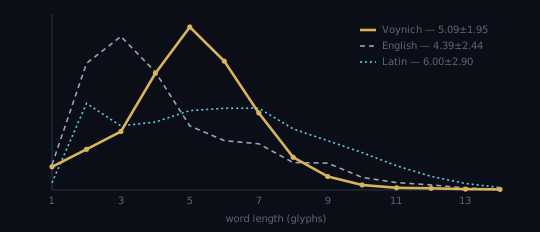
Rigidity again, from two more angles. First, length: real languages spread their words out with a long tail — short function words, long rare ones. The Voynich barely spreads at all. Its words cluster in a tight, near-symmetric hump around five glyphs (mean 5.09, SD 1.95) — narrower, relative to its mean, than either language beside it.
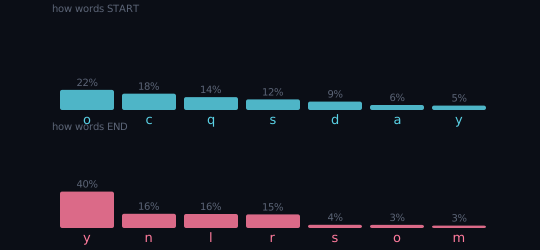
And they are. Look at where glyphs are allowedto sit. A Voynich word is not a free string — it is a slot machine: certain glyphs almost only open a word, others almost only close it.
4 · But it is not noise, either
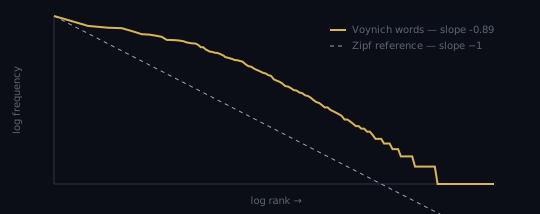
Here is why the manuscript is a genuine puzzle and not a doodle. All that rigidity could be random stamping — except the word frequencies obey Zipf’s law, the rank-frequency signature every human language shows and random text does not. The most common word is about twice the second, three times the third, and so on down a near-straight log-log line, slope -0.89— a hair under the classic −1.
5 · Two voices in one book
One more structure, and it is a real internal seam. Prescott Currier noticed in the 1970s that the manuscript is written in what look like two dialects— and the transliteration’s own metadata tags each page A or B. Split on that tag and the vocabularies come apart in our hands: the same alphabet, two different languages of it.
Currier A · 10,932 words
daiin 456 · chol 260 · chor 166 · s 162 · shol 108 · ol 99 · or 98 · dy 96
built on chol, chor, sho-
Currier B · 23,150 words
chedy 489 · shedy 422 · ol 420 · aiin 364 · qokeedy 303 · daiin 301 · qokain 274 · qokedy 266
built on qok-, -edy endings
The qok- words that dominate B are almost absentfrom A. This is not our imposition — it is in the book, measurable, and it means whatever generated the text ran in (at least) two distinct modes. A finding, held; not a translation.
The turn — the seam we will not cross
Now the honest part, the part every cracker skips. We have a precise map of the dark: rigid onset, moulded length, positional grammar, Zipfian vocabulary, two dialects. And none of it selects a meaning.Every one of those signatures is reproduced equally well by three utterly different origins — (a) a real language, heavily abbreviated or in an exotic writing system; (b) a cipher or shorthand over a real text; (c) a generation procedure— a person turning a wheel of syllables, or babbling to a template, producing lawful-looking text that says nothing. Low entropy and rigid slots, in particular, lean toward (c): recent cipher-benchmark work shows a hand-executable table can reproduce these very quirks. The structure is loud; the structure is silent on which of the three it is. To pick one is to collapse the answer— and the field’s whole history is people collapsing it wrongly, each certain, each with a “solution.”
The dark of the Voynich is real, it is huge, and it is precisely shaped. That shape does not reach meaning. Mapping the one and crowning the other are different acts — and only the first is earned.
Verdict
The Voynich manuscript is not random and not a normal language — measured own-code, its glyph order is 1.15 bits/letter more predictable than English, its words are stamped to a five-glyph template with a positional grammar, and it splits into two Zipfian dialects. That is the dark, and we hand it over in full. What we will notdo — what the discipline forbids — is read a meaning off it, because the identical structure fits a language, a cipher, and a babble-engine alike. No decipherment is earned from structure. The structure is the finding. The crown stays off.
Why our math sees more
Because it sees less, on purpose. Six hundred years of readers reached for the collapsed answer and produced cranks; the one move nobody makes is to stop at the structure and say so. Our framework is built for exactly this — the same rule (grade the held structure, not the collapsed answer) that told us to score the darka model holds instead of its final answer tells us to map the Voynich’s order instead of guessing its meaning. The manuscript is a six-century monument to the collapse trap. The honest reading is the one that refuses to fall.
Sources & method
corpus —ZL transliteration, R. Zandbergen & G. Landini, EVA 2.0 v3b (voynich.nu); Beinecke MS 408. Parsed own-code: 37,726 tokens, 8,236 types.
baselines — English: Austen, Pride and Prejudice (128,721 tokens); Latin: Caesar, De Bello GallicoI–IV (20,695 tokens) — both Project Gutenberg, same own-code pipeline (letter-only tokens, spaces between).
computed here —conditional entropy h₂ Voynich 2.15/ English 3.31 / Latin 3.30 bits; word length 5.09±1.95; q-initial 14.3% (qo- 98%); y-final 40%; Zipf slope -0.89; Currier A 10,932 / B 23,150 tokens. Own-code, stdlib only (vkit.py, compare.py).
the low-entropy lineage —the rigidity has been seen before (Bennett 1976; Stolfi; Montemurro & Zanette, PLoS ONE2013; Reddy & Knight 2011); recent cipher-benchmark work shows a hand-executable table can reproduce it — a reason (c) stays live, not a decipherment.
method parse the raw file · run the same pipeline on real languages · report the structure · refuse the meaning
ethos grade the held structure, not the collapsed answer · the dark is real even when the answer is not earned · no god number, a god hold
Dark Math The Observer’s Index — dark = the consistent, light = the medium of observation. Release 016 · the unread, arc 1 · the Voynich, held.