The Babble Engine
A meaning-free order-3 Markov model — own-code, seeded, no dictionary — reproduces the Voynich manuscript's word length, entropy, positional grammar, and Zipf slope to within a few percent, and rebuilds over a third of its vocabulary from three-letter fragments. That kills the 'too structured to be a hoax' argument. It does not prove the manuscript is meaningless: a real, highly regular language would land on the same low-order statistics too. The structure is real, cheap, and mute on what it is — both crowns stay off.
Last time we measured the Voynich’s dark and refused to read it, because the same structure fits a language, a cipher, or a machine that means nothing. That last option deserved more than a word. So we built the machine.Not a cipher, not a theory — a dumb generator with three glyphs of memory and a fixed coin, no dictionary, no grammar of meaning. Then we asked it to forge the most famous unreadable book in the world, and we scored the forgery against the original, own-code. If a machine this stupid can’t fake the manuscript, the manuscript has real depth. If it can, that depth was never evidence of meaning.
Where we land:held open. A meaning-free Markov model reproduces every Voynich signature — killing “too structured to be a hoax” without proving it meaningless. Both crowns stay off.
1 · The machine
It is an order-3 Markov modelover glyphs. Train it on the real Voynich word-shapes; all it learns is “after these three letters, here is how often each letter comes next.” To write a word it starts blank and rolls its loaded dice, glyph by glyph, until it rolls a stop. That is the whole mind of it — local letter habits, nothing more. No meaning can hide in three letters of memory. We seed the coin (408, the manuscript’s shelf-mark) so every number here is reproducible.
2 · The test, stated before the run
Free-to-fail, and marked plainly: the signatures that make the Voynich look too structured to be a hoax are its word length, its low entropy, its positional grammar, and its Zipfian vocabulary. Prediction: if the manuscript’s mystery is really just low-order letter-habit, this toy reproduces all four. If instead it carries structure a 3-glyph memory can’t hold, the forgery will break on at least one — and that break would be the first hard evidence of depth. One honesty flag up front: entropy h₂ is a two-letter statistic, so any order ≥ 1 model matches it by construction. The real tests are the ones the machine was never shown: the length curve, the Zipf slope, and how many real words it accidentally rebuilds.
3 · The forgery holds
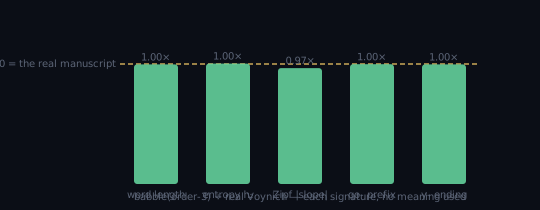
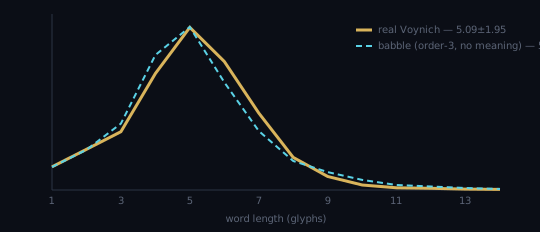
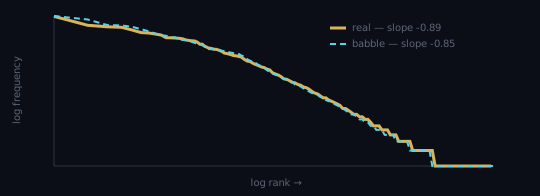
It reproduces all four, to within a few percent — on signatures it was never fit to.
4 · Read them and guess
Twenty words from the manuscript, twenty from the machine. One of these was written by a human being six hundred years ago and has defeated every cryptographer since. The other is dice.
The machine · order-3, no meaning
tchody al olkeedar shos okeey arar qoteol or taiin cthalody qkain arodly daiin daiin dain oteopcheodain cheopchedy ckholdy oly aiin
Beinecke MS 408 · real
fachys ykal ar ataiin shol shory cthres y kor sholdy sory ckhar or y kair chtaiin shar ase cthar cthar
The machine rebuilt 37% of its word-types into actualVoynich words — including daiin, the manuscript’s commonest word — having only ever seen three-letter fragments. The rest are new, and you cannot tell which.
The turn — and why we stilldon’t crown it a hoax
Here is where every “the Voynich is a hoax” headline overreaches, and we won’t. A machine matching the manuscript proves the structure is reproducible without meaning. It does not prove there is no meaning — because a real language that happens to be highly regular (heavy abbreviation, a syllabic script, rigid morphology) would land on the same low-order statistics too. Low-order structure is silent both ways.What the engine actually kills is a specific claim — the decipherers’ favourite: “the text is too structured to be meaningless.” That argument is now dead, by construction: this much structure is exactly what a meaningless three-glyph habit produces. The manuscript may yet mean something. Its statistics are not the evidence, in either direction.
The structure is cheap — a coin with a three-letter memory buys all of it. Cheap structure can’t testify. It cannot say “I mean something,” and it cannot say “I don’t.”
One place the toy does fall short, kept on the page: it was trained on all words at once, so it does not reproduce the two-dialectsplit (Release 016) or the section-specific vocabularies — the manuscript carries a little structure above the third order. But a mode-switching generator handles that with one more coin, and it is still not meaning. The sweep below shows the honest trade: raise the order and the machine matches better only by memorisingmore real words — the structure it invents is always cheap.
| engine | h₂ | Zipf | rebuilt real words |
|---|---|---|---|
| order-1 | 2.16 | -0.59 | 16% |
| order-2 | 2.16 | -0.80 | 29% |
| order-3 | 2.16 | -0.85 | 37% |
| order-4 | 2.16 | -0.92 | 48% |
| real | 2.15 | -0.89 | — |
Verdict
A meaning-free order-3 machine, own-code and seeded, reproduces the Voynich’s word length (5.07 vs 5.09), conditional entropy, positional grammar, and Zipf slope (-0.85vs -0.89), and rebuilds 37% of its vocabulary from three-letter fragments. Therefore the famous “too-structured-to-be-a-hoax” argument is refuted — and, symmetrically, the match is notproof of hoax, because a rigid real language matches too. The manuscript’s structure is meaning-neutral: real, cheap, and mute on what it is. Both crowns stay off.
Why our math sees more
Because it will not take either bribe. The decipherer collapses the manuscript to a meaning; the debunker collapses it to a hoax; both crown an answer the evidence doesn’t earn. We built the cheapest possible machine that fits the data and stopped exactly there — the free-to-fail test that couldhave exposed depth, run in public, returning “cheap.” That is the whole method: measure how much structure the dark actually holds, and refuse to read a verdict it cannot support. The Voynich’s dark is genuine and it is three letters deep. What it means, if anything, is still nobody’s to crown.
Sources & method
engine — own-code order-k glyph Markov (babble.py), trained on the ZL Voynich word-shapes, seed 408, 37,327 words emitted per order. No dictionary, no content model.
computed here —babble(order-3) vs real: length 5.07 vs 5.09; h₂ 2.16 vs 2.15; Zipf -0.85 vs -0.89; qo‑ 13.9% vs 14.0%; y‑final 40% vs 40%; 37% of emitted types are real Voynich words. Own-code, stdlib only.
lineage —generative accounts of the Voynich’s statistics: Rugg 2004 (Cardan-grille hoax generator); Timm & Schinner 2019 (self-citation/auto-copying); Stolfi’s core-mantle-crust word grammar; Montemurro & Zanette 2013 (the information content that a low-order model does not capture). Companion: Release 016 (the structural pass).
method build the cheapest machine that fits · state the free-to-fail test first · score the forgery own-code · refuse both crowns
ethos grade the held structure, not the collapsed answer · cheap structure cannot testify · no god number, a god hold
Dark Math The Observer’s Index — dark = the consistent, light = the medium of observation. The unread · arc 1 · the babble engine.