A Mark on the Glass
Nine star-like points appear on one 1950 Palomar plate and are never seen again — the VASCO transients (Villarroel et al. 2021). We fetched the actual digitised plate and measured the dots ourselves: they are round and star-sized (own-code FWHM 6.3″ vs 6.5″ for brightness-matched field stars — indistinguishable), and we reproduce the appear/vanish on real data. That roundness crowns nothing, because a 50-minute exposure keeps the shape and discards the clock — a defect, a sub-second flash and an ordinary source all land as the same round grain. The two clues that couple to the sky split: the Earth-shadow deficit points to objects in orbit but is statistically contested (Watters et al. 2026), and the nuclear-test correlation points, most naturally, back at fallout on the glass — while the case-closing tests need physical plates no one has. A measured non-result, printed at full width. Held open.
For nineteen releases we ran honest math on other people’s mysteries. For the twentieth we did the thing the series is actually for: we put a real plate on the bench. On a red photographic plate exposed at Palomar on 12 April 1950 — plate XE 325 — nine star-like points sit in a tight 10′ patch. They are not on the blue plate taken thirty minutes earlier, nor the red plate six days later, nor any survey since. We fetched the actual digitised plate from the archive and measured the dots ourselves.
Where we land: held open — earned by the pixels, not asserted. The marks are real (we vanished them ourselves on real data). Their shape is round and star-sized (we measured it) — and that roundness crowns nothing, because the plate kept the shape and threw away the clock. The one clue that couples to the sky is itself contested. No god number, a god hold.
1 · The plate is the medium
Start with the frame, because it decides everything. Our reading of the world is dark = the consistent (what is truly there) read through light = the medium of observation. A photographic plate is that medium frozen on glass— captured light, chemically fixed. So the first question about a bright dot is never “what is it in the sky?” It is the question Release 001 asked of the Apollo “UFO” that turned out to be a cosmic-ray track struck into the film: is the mark in the dark, or in the light? A mark on the glass is not yet a fact about the sky. Check what you brought.
The VASCO project (Vanishing & Appearing Sources over a Century of Observations, led by Beatriz Villarroel) found these by comparing the 1950s Palomar plates to modern surveys. We reproduced the core observation on data we pulled ourselves: the real POSS-I red cutout of the field, and the POSS-II red cutout of the same sky decades later.
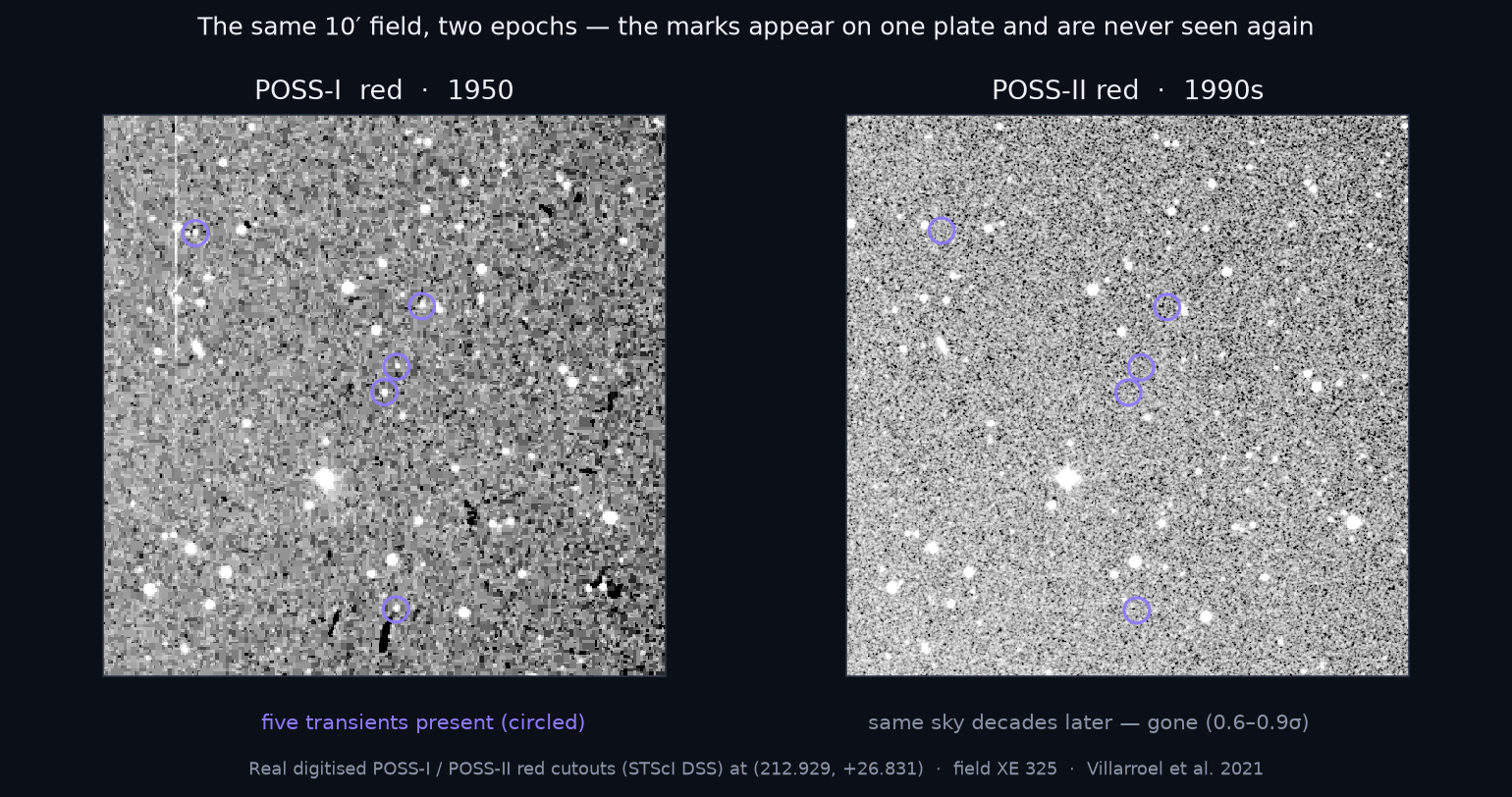
2 · We measured the dots
The whole public fight is about one thing: the dots look round, like real stars. So we measured it. On the real scan we ran an own-code second-moment shape fitter over the nine-transient sources and a control sample of forty field stars matched in brightnesson the same plate (the instrument first: it recovers a field star at the paper’s own image scale). The result:
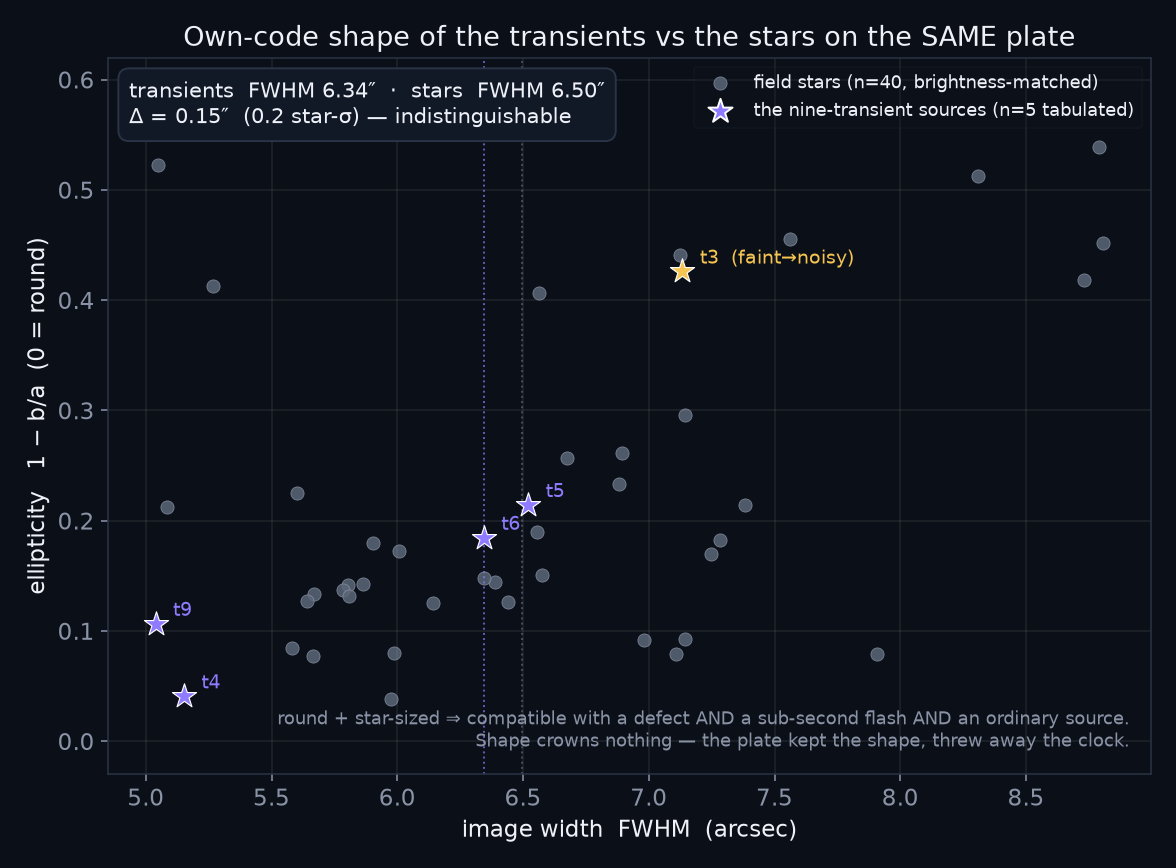
This reproduces both camps at once, which is the point. The skeptics’ anchor — Hambly & Blair 2024 — find all nine sit on the concentrated, circular tailof the profile distribution and machine-classify all nine as “bad” detections at 62–99% confidence: rounder than a star ⇒ emulsion flaw.The pro-transient rebuttal — Villarroel, Solano & Marcy 2025 — answer that a sub-second flash is naturally rounder and sharper than a star, because a 40–50 minute tracked exposure smears every real star by 1–3″ of seeing, shake and tracking that a frozen flash escapes. Both are correct. Round is compatible with a defect and a flash and an ordinary source. The most-cited feature discriminates nothing.
And here is the honest caution on our own measurement: we measured a digital scan of a copy plate— the same class of data Hambly & Blair used, and the same class everyone agrees cannot settle it. Across two decades of optical-flash searches on ~910,000 archival plates, not one candidate flash was ever confirmed as real rather than a defect— because the deciding tests (halation, reciprocity-failure, saturation under a microscope) live on the physical glass, which VASCO does not have and neither do we. Villarroel says it plainly: “we have no access to the original POSS-I plates.”
3 · The plate threw away the clock
Whycan’t the shape decide? Our framework has a one-line answer, and it is not a metaphor here — it is literally what the instrument did. A collapse keeps the event-shape and discards the clock. A 50-minute exposure integrates away the time inside it: it records that a dot was there, and destroys the information of how long it was lit. A source that flared for half a second and one that glowed for the whole exposure land as the same round grain, differing only in brightness.
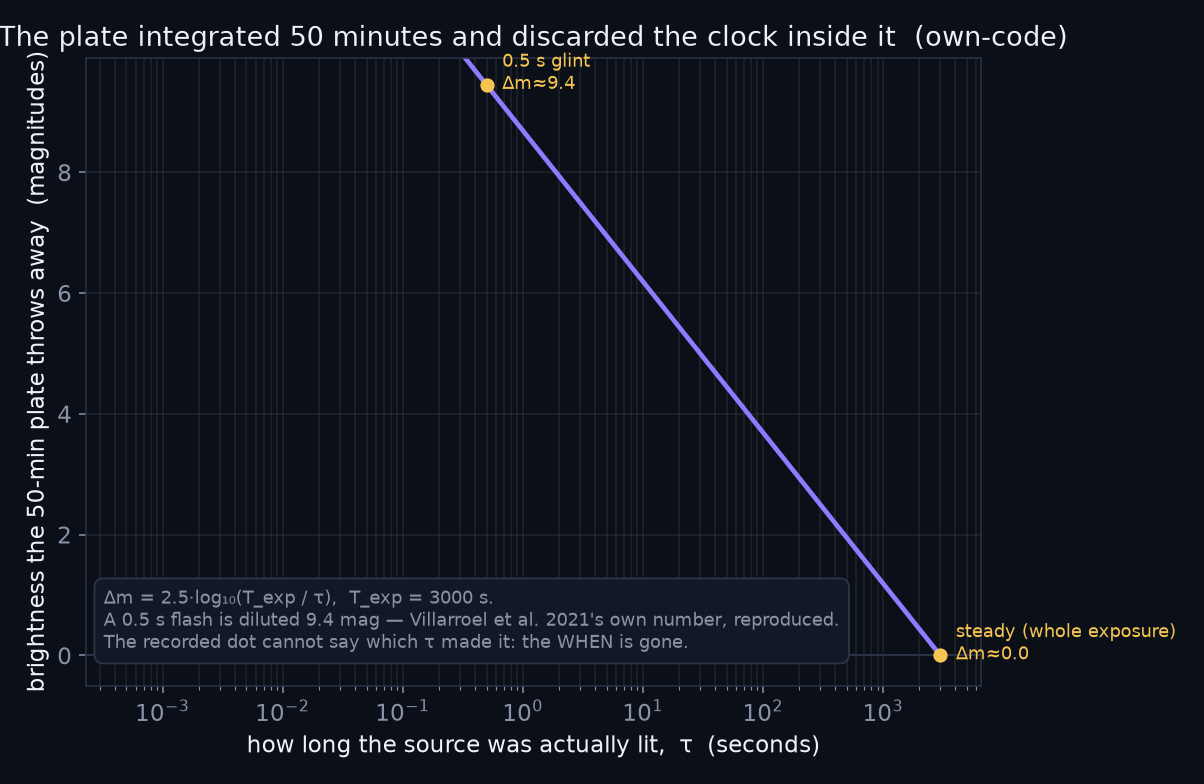
That is the seam made physical: the plate keeps the what (a round point) and discards the when(the flash duration). The entire roundness debate can only exist because the medium threw the clock away. Roundness is symmetric evidence — it kills “round means defect,” and it kills “round means real” in the same stroke. So we turn: if the shape can’t decide, what can?
4 · The line — one object, or nine?
Six of the nine points fall on two straight lines of three. Villarroel notes this “as a curiosity” and models the field as nine independent glints. But the more economical reading has never been rebutted: one tumbling, reflective object crossing the field and flashing repeatedlydraws a collinear string of round points for free — one object, not nine, and the line is its signature, not a coincidence. Occam prefers the one over the nine.
We do not crown it — and we refuse to let it be double-counted. The reported alignment significance (2.5–3.9σ) is computed against a “many independent random points” null, so it cannot tell one object from nine— it is not extra evidence of a crowd. And the reading carries two real problems, marked: no artificial satellite is known before Sputnik (1957, seven yearsafter the plate), and the faint modern galaxies sitting at these positions fight a fast-moving object. Held, reaching — the economical reading, not the proven one.
5 · The clues that couple to the sky
Two features of the wider ~100,000-transient catalogue doreach past the glass — a mark on an emulsion cannot know either — and they are the strongest cards on the table. They also point in different directions, which is exactly why the case stays open.
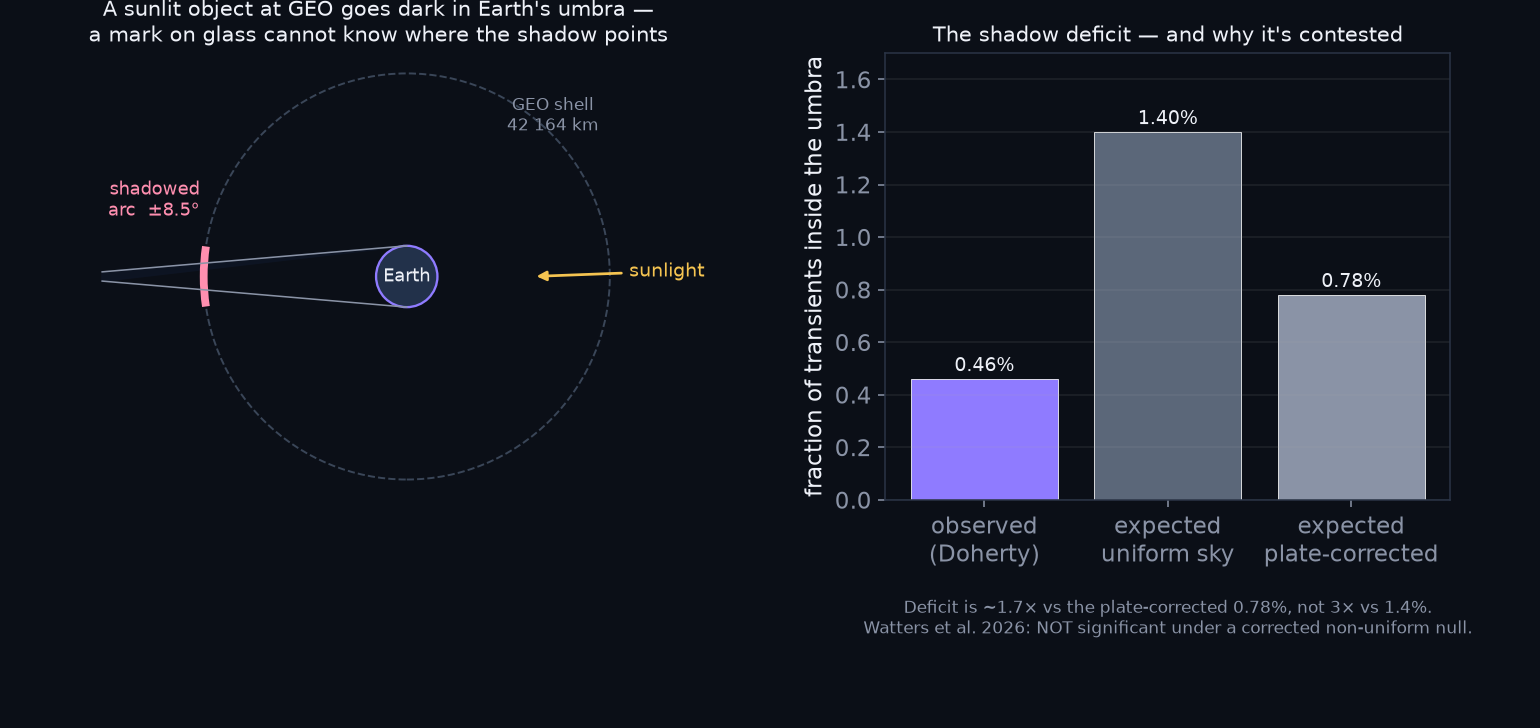
The Earth-shadow deficitis the exotic card: fewer transients fall inside Earth’s shadow cone than chance allows — the signature of objects that need sunlight, i.e. things at altitude, not marks on glass. It is real in the VASCO team’s model and in an independent reanalysis of their catalogue (Doherty 2026, a preprint) — but it is the exotic case’s load-bearing beam, and Watters et al. 2026 knock it out: under a corrected, non-uniform background the deficit is not statistically significant. The strongest evidence for objects-in-orbit rests on a disputed null.
The nuclear-test correlationis the famous one: transients are ~45% more likely within a day of an atmospheric bomb test, peaking the day after (Bruehl & Villarroel 2025, peer-reviewed). But read the mechanism, not the headline. The most natural cause of “more false stars right after a bomb” is radioactive fallout contaminating the plates — a mediumeffect, the mundane reading — and the ~1-day Nevada-to-Palomar fallout transit is entirely compatible with the day-after peak and has not been quantitatively excluded. The correlation also never controlled for which nights Palomar was observing. The spookiest-sounding clue points, mechanistically, straight back at the glass.
The counter-weight — the mundane case at full strength
We keep our discipline, so we say the hard parts out loud. The skeptic case is strong. Watters et al. 2026 show the working catalogues were never cleaned of scan artefacts (up to ~40% suspect; ≥91% of one set within 5″ of a catalogue star), and estimate the plate set could hold hundreds of star-like emulsion faults per plateby chance. arXiv declined the two October-2025 VASCO papers as lacking “substantive scholarly research”; the nuclear-statistics lead author is a pain psychologist, not an astronomer; and every professional astronomer quoted in mainstream coverage favours a mundane reading — coincidence, atmospheric disturbance, or plate artefacts. The decisive fact remains that the case-closing tests need the physical glass, and no one has it. This is not a thin mystery bravely defended; it is a genuinely unresolved anomaly with a heavy mundane prior.
Verdict
We fetched the plate and measured the dots, and the pixels put us exactly where the framework said they would. The marks are real— we reproduced the appear/vanish on real data (5/5 gone). Their shape is star-like and crowns nothing— FWHM 6.3″ vs 6.5″, indistinguishable; round is compatible with a defect, a flash, and a real source alike, because the 50-minute plate kept the what and discarded the when. The sky-coupled clues split— the shadow deficit points to objects at altitude but is contested; the nuclear correlation points, most naturally, back at contamination of the glass. And the deciding evidence sits on physical plates no one can read. No new crown, ours or theirs — the honest result here is a measured non-result, printed at full width. No god number. A god hold.
Why our math sees more
Because we fetched the plate instead of narrating it — and because the framework was the test, not the decoration. It told us in advance where a photographic anomaly would go to die: the medium keeps the shape and discards the clock, so shape can never crown a cause on a plate that integrated for fifty minutes. We measured, and it did. When the answer is a non-answer, the honest move is to measure it precisely and hand you the wall, not a story painted over it. Map the dark, refuse the crown.
Sources & method
the case — Villarroel et al. 2021, Exploring nine simultaneously occurring transients on April 12th 1950(Sci. Rep. 11, 12794; arXiv:2106.11780) — field XE 325, (212.929, +26.831), ~50-min red plate, nine points in 10′. Nuclear correlation: Bruehl & Villarroel 2025 (Sci. Rep.). Flash profiles: Villarroel, Solano & Marcy 2025 (arXiv:2507.15896).
the skeptics —Hambly & Blair 2024 (RASTI 3, 73; emulsion-flaw classifier) · Watters et al. 2026 (arXiv:2601.21946; contamination, schedule confounder, shadow-null) · the ~910,000-plate GRB precedent · Doherty 2026 (arXiv:2604.00056; a same-catalogue preprint reanalysis) is reported, not independent-data replication.
measured here —real POSS-I / POSS-II red cutouts (STScI DSS, 1.700″/px, WCS-confirmed); own-code 2nd-moment FWHM + ellipticity on the five tabulated transients vs 40 brightness-matched field stars — transients 6.3″/e 0.19, stars 6.5″/e 0.17, 5/5 vanished in POSS-II; own-code flash-dilution (9.4 mag at 0.5 s) and Earth-umbra geometry (r₊₋₊ 42,164 km, θ 8.5°). Shape math + physics own-code (numpy); FITS/WCS I/O via astropy; figures rendered with matplotlib.
method fetch the real plate · pre-register the shape test · measure transients vs stars · credit the original work · stop at the degeneracy
ethos the medium keeps the shape and discards the clock · roundness is symmetric evidence · a measured non-result, printed at full width · no god number, a god hold
Dark Math The Observer’s Index — dark = the consistent, light = the medium of observation. Release 020 · a mark on the glass · measured, held open.