The Held Image
One dark-math move — hold the structure the pixels collapse from — pointed at imaging in three directions: recognition, generation, and 3D. In each direction the lab pre-registered a fancier, learned reach meant to beat the simplest structure-first method, and in each direction its own test refuted the reach: the learned face-embedding lost on strangers (open-set), the learned control-head lost to plain difference-of-means, and the wide-baseline chain was refuted — the regime picks the tool. The simple baselines are real and measured; the reaches are printed exactly where they failed. A kept, honest negative — not a win.
Imaging has one habit everywhere you look: it grades the light. Face recognition grades embedding scores out of a black box; image generation grades how photoreal the render looks; generative 3D grades the rendered frame— FID and FVD on views — and never asks whether the world underneath stayed the same world. Our lab’s one idea, pointed at imaging, is the opposite habit: hold the dark— the structure the pixels collapse from — and treat every image as one collapse of it. This post is what that math does across three directions with one move. It is also a kept negative: in each direction we pre-registered a reach— a fancier or learned upgrade meant to beat the simplest structure-first method — and in each direction our own test refuted it. The simple baselines are real and measured; the reaches are printed exactly where they failed.
Where we land:resolved — a kept, honest negative. Three learned reaches, each refuted by the lab’s own pre-registered test; the simple structure-first baselines win. Not a win we chased — one we kept.
1 · The move — dark, light, and one collapse
The math is one sentence: an image is not the thing; it is a collapse ofthe thing. Behind any set of observations there is a compact, view-stable structure — the dark — and each observation is that structure rendered under a nuisance: lighting, pose, viewpoint. So the engine’s primitive is project(image) → structure and reconstruct(structure) → image, and the whole field folds into three directions of that single move: in— project an observation to the held identity and match coordinates (recognition); out— move through the structure along a named direction and render (generation); across— hold one structure while views accumulate (3D). Everything below is those three directions, measured — reaches and all.
2 · Collapse in — recognition, and its refuted reach
The field’s default is a deep embedding: accurate at web scale, unreadable by construction. The structure-first version separates the nuisance from the identity as math— a from-scratch light-model (the Retinex/SQI family) solves the lighting, then a linear map (PCA → Fisherfaces) holds the identity as a coordinate you can print. On the classic hard-lighting benchmark (Yale-B: 38 subjects, 30 training images each, identical split for both sides) the CPU stdlib reading measures 0.993 / 0.995 against the convolutional net’s 0.924±0.011 / 0.965±0.003. Read the fence with the number: this is the few-shot, hard-lightingregime. Give a deep net a million identities and it wins — that is its regime, not this one.
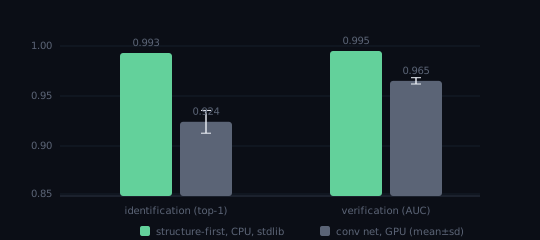
compute_measured.json). Few-shot, hard lighting: at 30 images a person the conv has too little data to learn lighting, and the light-model solvesit. The fence stands: give a deep net a million identities and it wins — that is its regime, this one is ours.The structure-first reading is also far lighter by construction— fewer parameters, fewer operations, no GPU anywhere. But read those op-counts next to the honesty panel, because they are structural counts, not wall-clock:
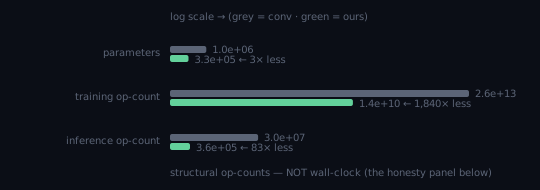
The honesty panel, three stories kept separate.Story one — structural — is the figure above. Story two — wall-clock today — goes against us: the GPU conv trains in 23 seconds; our pure-Python build takes 1,852 — an interpreter loses to compiled CUDA even while doing far less arithmetic. Implementation fact, not structure fact; printed, not hidden. Story three — the compiled floor where the op-counts become real seconds — is a projection, labelled as one. And the reach: we pre-registered an attempt to beat our own linear model with a learned embedding. Closed-set it passed (1.0000 vs 0.9890); open-set — strangers, the case that matters — it was REFUTED (0.9425 vs 0.9366 — above the linear, but short of the pre-registered +0.01 margin). The linear structure ships; the learned reach does not. Two properties come free with the reading: on-device (faces never leave the machine) and auditable(coordinates you can inspect, not activations you can’t).
3 · Collapse out — generation, where the fancy control lost
The field’s generators are astonishing at the light — photoreal anything — and that is exactly their governance problem: a machine that can render anyone can impersonate anyone. Run the collapse the other way through held structure and the trade inverts: movement along named directionsin structure-space (“older”, “smiling” — 37 attributes evaluated), inside a learned span — which means the generator cannot mint a stranger: geometry, not policy. The control is real and measured — held-out selectivity 1.151 against a random floor of 0.912. And the reach missed: our attempt to upgrade the control with a learned ridge head was REFUTED by its own pre-registration(0.988 mean selectivity, a 41% win-rate against the simple method’s bar of 60%). The plainest dark direction held; the fancy one did not.
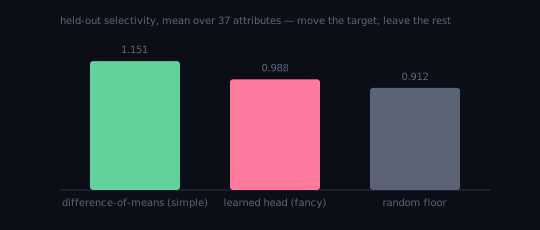
text_face_head.json). Both real methods clear the random floor — the directions carry true signal — and the simple one clears it further while the learned head falls short of its bar. Fences at full width: fixed vocabulary, not free text; structure-space renders, not photoreal; research-only data, which is why this post has numbers and no faces.4 · Hold across — 3D, where the reach was refuted
Generative 3D is the youngest direction and the clearest case of the field grading the light: benchmarks score rendered frames (FID/FVD) and never the held world— whether the structure underneath stays the same structure as views accumulate. The alpha builds the chain that question needs, from nothing: detection, a hand-built rotation-invariant descriptor (85% matching across a 45° rotation where a raw patch scores 2% — after a diagnosed failure at 1–12% taught us why), tilt simulation, per-feature affine, a RANSAC verifier on our own eigensolver and SVD (precision 68% → 88% under half-outliers), and incremental structure-from-motion — every stage scored against ground truth. Its first finding is the honest kind: our pre-registered reach (“the sophisticated chain will extend the map’s range”) was REFUTED. “Wide baseline” is not one thing, and no tool wins everywhere.
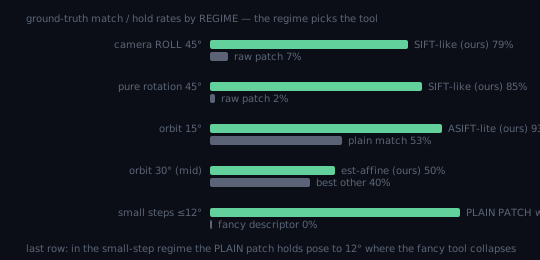
That refutation generalises the whole post: the regime picks the tool, and the simplest structure that fits the regime holds.It is the same lesson as the linear model beating the learned embedding on strangers, and difference-of-means beating the ridge head. Growing whole worlds on held, bonded structure — and the structure-first grading metric the field lacks — is the open aim, marked reaching until it survives its own pre-registered kill-tests like everything else here.
5 · What this says about the field
Three directions, one pattern. Where the task is structure the observer already understands — lighting on a face, a named attribute, a camera’s small step — writing the structure down measures well: accurate in the few-shot regime, lighter by construction, auditable because it is made of coordinates rather than activations, safe because its limits are geometric rather than promised. Where the task is open-world scale, the deep stacks win and we say so. But note what happened every time we reached pastthe simple structure to a fancier one: our own pre-registration refuted the reach — three times, in public. The argument the math leaves is narrow and kept: grade the dark, not the light; hold the structure, rent the pixels — and keep the reaches that miss.
Verdict
One move, pointed at imaging in three directions — and in each one we pre-registered a reach and our own test refuted it. The learned face-embedding meant to beat the plain linear model edged it by only +0.006 on strangers, the open-set case that matters (0.9425 vs 0.9366) — short of the +0.01 margin we pre-registered, so the reach is refuted and the linear ships. The learned control-head meant to beat plain difference-of-means lost to it (0.988, a 41% win-rate against a 60% bar). The sophisticated wide-baseline chain meant to extend the map’s range was refuted — “wide baseline” is not one thing, and in the regime that world-growing actually lives in, the humblest tool held where the fancy one collapsed. The simple structure-first baselines are real and measured; the reaches are not, and we printed each one exactly where it failed. We crown no imaging capability here.What we keep is the honest negative: pointed at the field, the fancier math lost to the simpler structure — three times, pre-registered, in public. Grade the dark, not the light.
Why our math sees more
Because it grades what the pixels collapse from— the structure, the dark — instead of the pixels themselves, and because it lays the fence before it reaches for the feature. Every reach in this post was named and pre-registered beforethe run, so when the learned embedding, the learned head, and the sophisticated chain each fell short, there was nowhere to hide the miss: it went on the page at full width. A method that keeps its refutations is the only kind whose survivors you can trust. So the math sees more twice over — it sees the structure a black box hides, and it sees its own reaches fail. That is the reading, and only what the test held is kept.
Sources & method
instrument records — TheEngine/Hue/identity/results/: compute_measured.json(accuracy + the three compute stories) · identity_embed{,_open}.json(the open-set refutation) · text_face_head.json (the control-head refutation). 3D: the recorded run 2026-07-05_ai-native-generative-3d/AUTONOMOUS-RUN-SYNTHESIS.md + TheEngine/Hue/scene3d/.
the stack — all own-code, stdlib only, zero third-party imports (proved by audit_separation.py): own image codec, eigen-solvers, light-models, Fisherfaces, SIFT-class descriptor, RANSAC, SfM. Benchmarks: Extended Yale-B, CelebA pilot (research-only, never shipped, no images herein).
method numbers from machine-emitted records · refuted reaches published · three compute stories kept separate · fences before features
ethos hold the dark, rent the light · the regime picks the tool · the simplest structure that fits, holds
Hue Papers The Observer’s Index — one dark-math move, three directions, pointed at imaging. Every reach that missed, kept on the page.